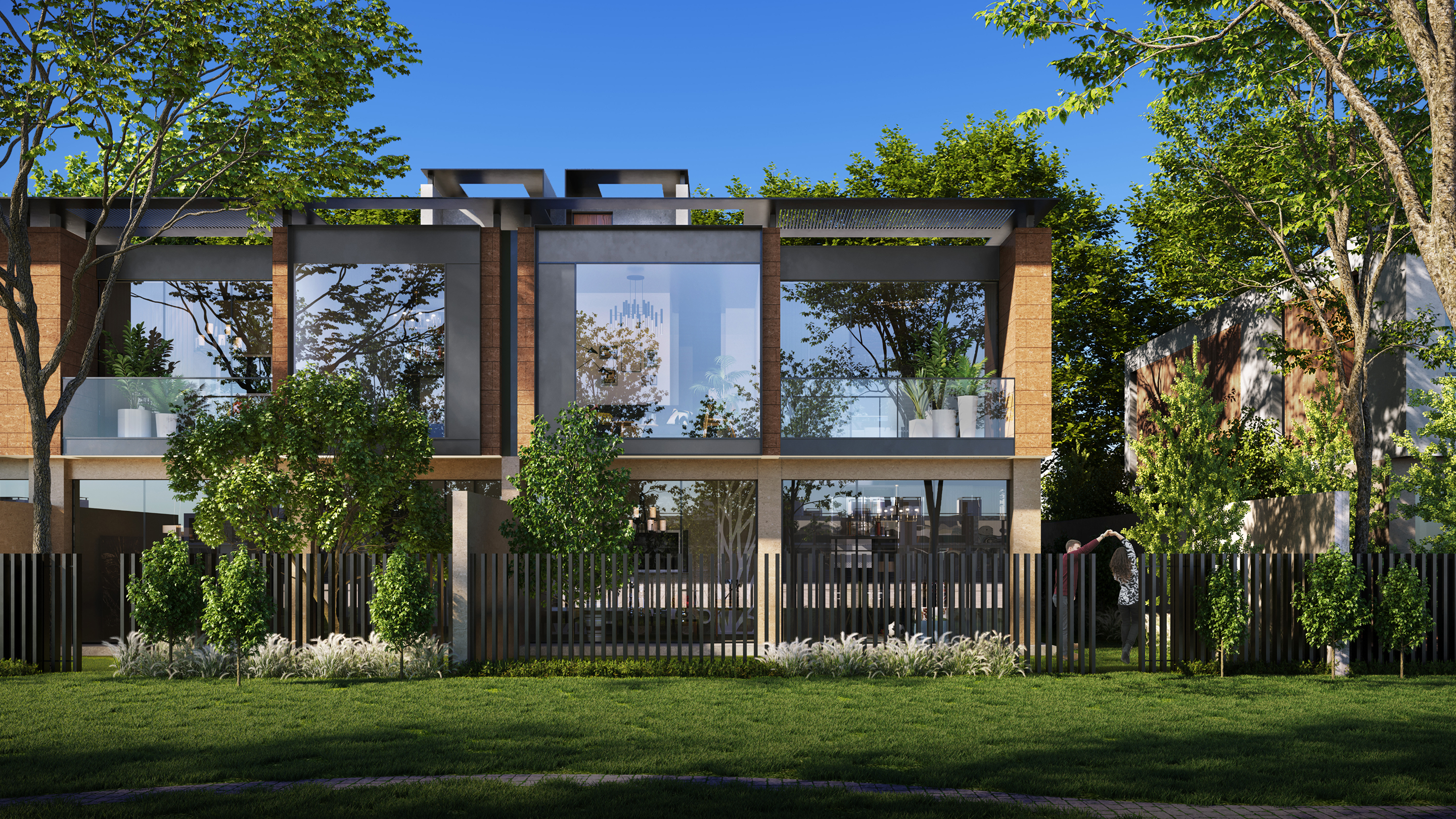
Estidama, the Arabic word for sustainability, is Abu Dhabi’s framework for sustainable property design, construction, and operation. Developed by the Abu Dhabi Urban Planning Council as part of Plan Abu Dhabi 2030, it is implemented through the Estidama Pearl Rating System, which rates developments from 1 to 5 Pearls.
No new project can be approved without achieving at least 1 Pearl. This requirement ensures new homes in Abu Dhabi meet measurable efficiency standards, resulting in lower utility bills and improved build quality from handover.
Key takeaways
- Estidama is Abu Dhabi’s mandatory sustainability framework, created by the Abu Dhabi Urban Planning Council under Plan Abu Dhabi 2030
- The Pearl Rating System, its enforcement tool, evaluates developments on a scale of 1 to 5 Pearls, with a minimum of 1 Pearl required for a building permit
- This system operates through three protocols for buildings, villas, and communities, assessed across seven credit categories of mandatory and optional criteria
- According to the Climate Policy Database, a 1 Pearl building reduces energy consumption by 30 to 35 percent compared to pre-2010 constructions
- For buyers, Estidama translates to lower utility costs, improved air quality, and greener master-planned communities, including those developed by Modon on Hudayriyat and Reem Islands
What is Estidama?
Estidama is Abu Dhabi’s sustainability initiative established by the Urban Planning Council. In 2017, the Council’s functions merged into the Department of Urban Planning and Municipalities, which became part of the Department of Municipalities and Transport in 2019.
Launched under Plan Abu Dhabi 2030, Estidama emphasises sustainability in new construction through four pillars: environmental, economic, social, and cultural sustainability. Its enforcement tool, the Pearl Rating System, has been a mandatory requirement since 2010.
What is the Pearl Rating System?
The Pearl Rating System is Estidama’s scoring mechanism, rating projects from 1 Pearl (minimum compliance) to 5 Pearls (highest sustainability performance). It applies through three protocols, shown below.
| Rating protocol | What it applies to |
|---|---|
| Pearl Building Rating System (PBRS) | Offices, retail units, multi-residential towers, schools, and mixed-use buildings |
| Pearl Villa Rating System (PVRS) | Individual villas and single-family residential developments |
| Pearl Community Rating System (PCRS) | Master-planned neighbourhoods and large-scale communities |
Even the minimum, 1 Pearl, already delivers a measurable gain. According to the Climate Policy Database, the 1 Pearl standard improves building efficiency by 30 to 35 per cent against the baseline that applied before Estidama became mandatory in 2010.
Pearl Rating levels explained
The difference between 1 Pearl and higher levels lies in optional credits. All rating levels, from 1 to 5 Pearls, must first meet mandatory credits across the seven Estidama categories. Higher Pearl levels require more optional credit points, and a 5 Pearl project significantly exceeds baseline compliance.
Notably, government-funded projects must achieve at least Estidama Pearl 2 requirements to obtain a building permit, which is one Pearl above the 1 Pearl minimum for private projects. To meet Estidama Pearl 2 requirements, a project must fulfil all mandatory credits and accumulate sufficient optional credits to surpass the 2 Pearl threshold.
Design, construction and operational ratings
Estidama certification progresses through three stages, tracking a project from inception to handover.
- The Design Rating: Evaluated during the approval phase, where a Pearl Qualified Professional integrates Estidama requirements into the plans, and obtaining a Pearl Design Rating is essential for issuing a building permit.
- The Construction Rating: Confirmed through site audits after the building’s completion, ensuring the final project aligns with the approved design.
- The Operational Rating: Applicable once the building is occupied and can only be pursued after a minimum of two years of operation with at least 80 per cent occupancy, assessing actual energy and water usage, as well as indoor air quality against the original design intent.
What are the Estidama guidelines?
The Estidama requirements outline seven credit categories, each with essential minimum standards that all developments must meet for approval, irrespective of their Pearl level. This is crucial even before construction begins, as off-plan buyers are investing based on these approved criteria rather than a completed property. Our guide to off-plan property in Abu Dhabi explains how this approval process influences purchasing decisions.
| Category | What it covers |
|---|---|
| Integrated development process | Cross-disciplinary planning between architects, engineers, and Pearl Qualified Professionals from day one |
| Natural systems | Protecting and restoring the site’s natural ecology and habitats |
| Livable buildings | Improving indoor and outdoor space quality, comfort, and connectivity |
| Precious water | Cutting potable water demand through efficient fixtures, reuse, and smart Estidama meters |
| Resourceful energy | Lowering energy demand and cooling loads across the building’s lifecycle |
| Stewarding materials | Sourcing responsibly and diverting construction waste from landfill |
| Innovating practice | Rewarding design or construction methods that go beyond baseline requirements |
Estidama vs LEED and BREEAM
Estidama is distinct from LEED and BREEAM in its origins and climate assumptions. While LEED, created by the U.S. Green Building Council, and BREEAM, established by the UK’s Building Research Establishment, are voluntary certifications used globally, Estidama is a mandatory requirement tailored for Abu Dhabi’s hot, arid climate.
| Factor | Estidama | LEED | BREEAM |
|---|---|---|---|
| Origin | Abu Dhabi Urban Planning Council / DMT | U.S. Green Building Council | Building Research Establishment (UK) |
| Climate focus | Built specifically for the hot, arid Gulf climate | Adaptable to varied climates and regions | Adaptable, with a strong UK and European base |
| Mandatory status | Mandatory for all new Abu Dhabi developments | Voluntary | Voluntary |
| Rating scale | 1 to 5 Pearls | Certified, Silver, Gold, Platinum | Pass, Good, Very Good, Excellent, Outstanding |
Why Estidama matters for property buyers
Estidama matters for property buyers as it transforms government regulations into lower running costs and a more comfortable home. Buildings that meet Pearl standards are more energy-efficient, use less water, and offer superior insulation and indoor air quality compared to those built before 2010. Homes equipped with Estidama meters enable households to monitor and manage their water usage effectively.
On a community scale, the Pearl Community Rating System promotes increased shading, walkability, and green spaces in master-planned developments, including Modon’s island communities on Hudayriyat and Reem Island. Prospective buyers can refer to our guide to buying property in Abu Dhabi, which outlines ownership rules and build-quality standards. Discover Modon’s current developments to see Estidama’s Pearl standards integrated into every home.
What Estidama means for your next Abu Dhabi purchase
Estidama is a required standard for all new Abu Dhabi developments, ensuring they meet specific efficiency criteria before obtaining a building permit. The Pearl Rating System measures compliance from design to operation, providing buyers with homes built to verified efficiency standards instead of mere developer promises. To see Estidama certification in action, check out Modon’s listings on Reem Island and Hudayriyat Island.
For buyers, Estidama translates to lower utility costs, improved air quality, and greener master-planned communities, including Modon’s flagship developments like Wadeem Gardens on Hudayriyat Island.
FAQs on Estidama
What does Estidama mean?
Estidama is the Arabic word for sustainability. It is Abu Dhabi’s mandatory framework for designing, building, and operating property, enforced through the Pearl Rating System.
Is Estidama mandatory in Abu Dhabi?
Yes. Every new development in the emirate needs at least 1 Pearl to receive a building permit, and government-funded projects need at least 2 Pearls.
What is the difference between Estidama and the Pearl Rating System?
Estidama is the broader sustainability initiative and its four pillars: environmental, economic, social, and cultural sustainability. The Pearl Rating System is the practical scoring tool that enforces it, rating each project from 1 to 5 Pearls.
How is Estidama different from LEED?
Estidama is a mandatory government requirement built for the Gulf climate, while LEED is a voluntary, globally adaptable certification developed in the United States.
References
- Al Tamimi & Company. (2020, April 28). Estidama: The sustainability initiative of the Abu Dhabi Urban Planning Council.
- Climate Policy Database. (n.d.). Estidama Pearl Rating System for new residential and commercial buildings.
- Department of Municipalities and Transport. (2025, January 8). Abu Dhabi City Municipality promotes sustainable green building concept and projects.
- Department of Municipalities and Transport. (n.d.). About us.
- Department of Municipalities and Transport. (n.d.). The Pearl Rating System for Estidama: Public realm rating system (Version 1.0).
- Ecohome. (n.d.). BREEAM rating system: How does it compare to LEED and other green home certifications?
- Prometric. (n.d.). Estidama Pearl Rating System.
- Stonehaven. (n.d.). Estidama Pearl Rating System: Explained.